
Flat Roofing Systems, Compared for Alberta
Five systems dominate Edmonton's flat and low-slope roofs. They are not interchangeable. This is a plain explanation of how each one behaves through a prairie winter, what it costs relative to the others, and which building each actually suits.
At a glance
The short version.
- 01 SBS Modified bitumen · torch-on Cold, complex details, foot traffic 20–30 yrs
- 02 TPO Single-ply · heat-welded Large fields, reflectivity 20–30 yrs
- 03 EPDM Single-ply · synthetic rubber Simple fields, budget scope 20–30 yrs
- 04 CBC Cold-applied built-up · multi-ply Occupied buildings, no open flame 20–30 yrs
- 05 Built-Up Multi-ply · tar & gravel Legacy buildings, heavy protection 20–30 yrs
Every one of these can give you 20–30 years if it is specified correctly for the building and installed properly. Service life is decided far more by detailing and maintenance than by which membrane you pick off a list.
Why the Alberta climate decides this
A flat roof in Edmonton has to survive a roughly 70 °C annual temperature swing, dozens of freeze–thaw cycles a season, significant snow load, prairie hail and long hours of summer UV. That combination punishes two things above all: seams and details — the flashings, curbs, drains and parapets where the flat field meets something else.
This is why a system that performs beautifully in a mild coastal climate can disappoint here, and why the honest comparison isn't "which membrane is best" but "which membrane holds its details through this specific abuse."
01 · SBS Modified Bitumen
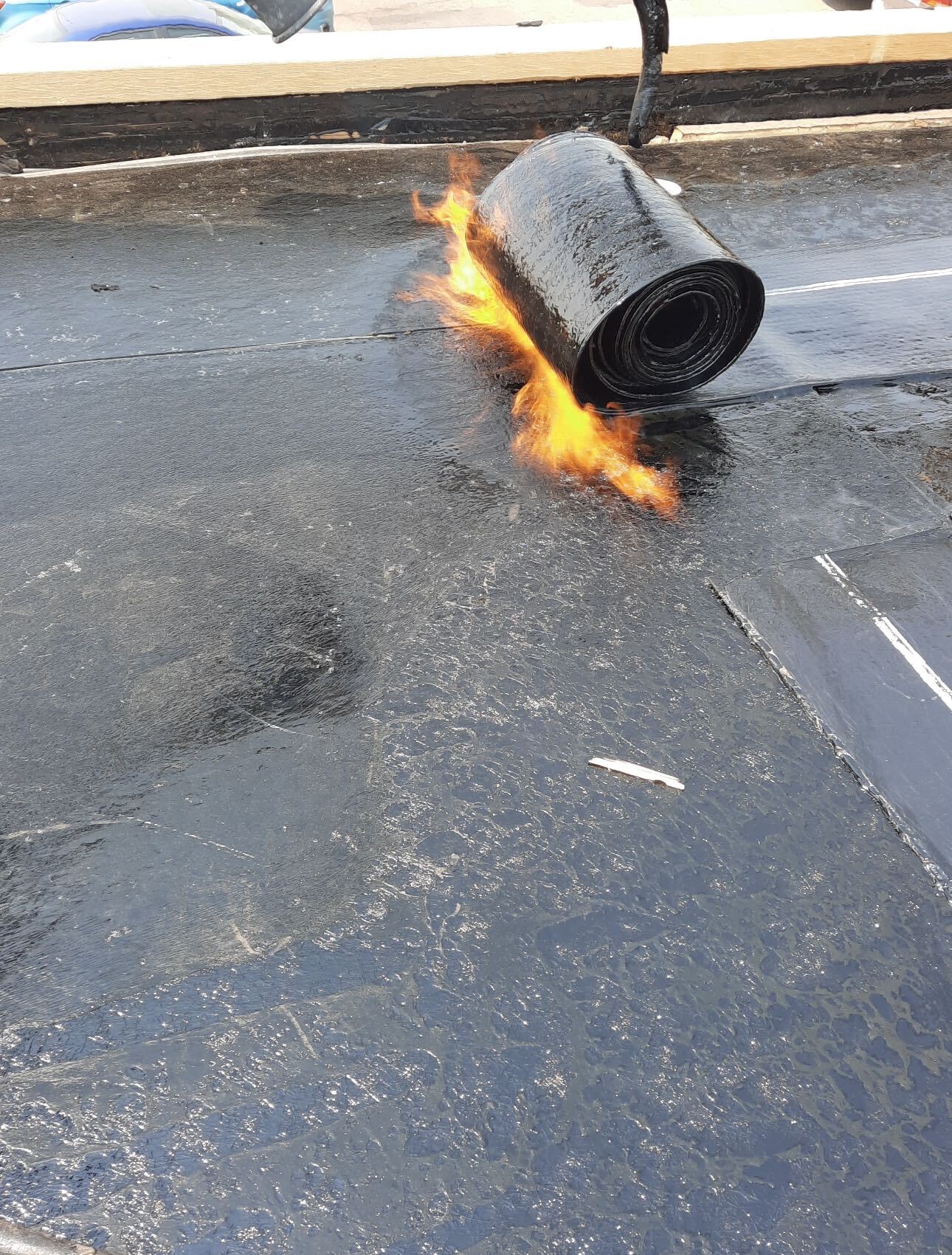
A reinforced asphalt membrane, applied in two plies — a base sheet and a granulated cap sheet — either torch-applied or with a cold adhesive. It is the most common commercial flat roofing system in Alberta, and it is what we specialise in.
Why it dominates here
- It stays flexible in cold. The rubber modifiers (styrene-butadiene-styrene) let the membrane move through freeze–thaw instead of going brittle and cracking.
- Two plies means redundancy. A puncture through the cap doesn't automatically mean water in the building.
- It details well. Around curbs, drains, parapets and awkward penetrations, torch-applied membrane conforms and bonds where a rigid sheet fights you.
- It takes traffic. Rooftop mechanical means people walking on the roof. The granulated cap handles that better than most single-plies.
Trade-offs, honestly
- Torch application involves open flame, so it demands a properly trained crew and fire-watch discipline. This is a real safety consideration, not a marketing point.
- The dark surface absorbs heat — less reflective than a white TPO field, which matters more for cooling load on large buildings.
- Installation is more labour-intensive than rolling out a single-ply sheet.
Best fit: most Edmonton commercial and multi-family buildings, particularly anything with complicated detailing, rooftop mechanical, or regular foot traffic.
02 · TPO (Thermoplastic Polyolefin)
A single-ply thermoplastic sheet, mechanically fastened or adhered, with seams joined by hot-air welding. Usually white, and the reflective option most people mean when they say "cool roof."
- Reflectivity. A white TPO field pushes solar gain back off the building, which can meaningfully reduce summer cooling load on large-footprint buildings.
- Welded seams. Done properly, a hot-air weld fuses the sheets into effectively one piece — a genuinely strong seam.
- Fast on big simple fields. On a large warehouse with few penetrations, TPO goes down efficiently.
Where it struggles
- Detailing around complex penetrations is more fiddly than with torch-applied membrane.
- Product quality varies significantly between manufacturers and formulations — TPO is a category, not a single standardised product.
- Cold-weather installation windows are tighter.
Best fit: large, simple commercial and industrial fields where reflectivity and cooling load matter more than complex detailing.
03 · EPDM (Synthetic Rubber)
A single-ply synthetic rubber membrane — typically black — that is ballasted, mechanically fastened or fully adhered. One of the longest-established flat roofing systems, with decades of real-world performance data behind it.
- Proven and forgiving. It handles temperature movement well and has a long track record in cold climates.
- Simple and economical on large uninterrupted areas with straightforward detailing.
- Repairable. Patching EPDM is well-understood and generally uncomplicated.
Where it struggles
- Seams are traditionally adhesive or tape-based rather than welded, so seam maintenance matters more over the life of the roof.
- Black absorbs heat — the opposite of TPO's reflectivity argument.
- Ballasted systems make leak-tracing harder, because you have to move the ballast to find anything.
Best fit: large simple roof fields where budget matters and detailing is straightforward.
04 · CBC (Cold-Applied Built-Up)
A multi-ply built-up roof where the plies of reinforcing felt or fabric are bonded with a cold-applied adhesive instead of hot asphalt or a torch. You get the layered redundancy of a traditional built-up roof without kettles or open flame on the job.
- No open flame. No torches and no hot kettles, which makes it a strong fit for occupied buildings, tight urban sites and roofs where fire risk has to be kept to a minimum.
- Multi-ply redundancy. Several plies means damage to the top layer doesn't automatically mean water in the building.
- Less odour and disruption. Tenants, staff and neighbours can keep working while the roof goes on.
Where it struggles
- The adhesive needs time and suitable temperatures to cure, so scheduling matters more in an Alberta shoulder season.
- Heavier and more labour-intensive than rolling out a single-ply sheet.
Best fit: occupied buildings, schools, healthcare and multi-family, and any roof where open flame isn't an option.
05 · Built-Up Roofing (Tar & Gravel)
The traditional system: multiple plies of bitumen and reinforcing felt, finished with a gravel ballast surface. Much of Edmonton's older commercial stock still has one.
- Very durable — multiple redundant plies, and the gravel gives real protection against UV and impact.
- Long track record. Plenty of built-up roofs have well exceeded their expected life.
Where it struggles
- Heavy — the structure has to be designed for it.
- Leak-tracing is genuinely difficult: water travels between plies and under gravel, so the entry point is often nowhere near the interior stain.
- Messy and labour-intensive to install and to tear off.
Best fit: mostly legacy buildings. On new work it's now uncommon — more often it's what we're removing and replacing.
What actually determines how long your roof lasts
Every system above is rated in a similar 20–30 year band, which tells you something important: the membrane choice is not the biggest variable. These are, roughly in order:
- Detailing quality. Flashings, curbs, drains and parapets are where roofs fail. Field membrane rarely fails in the middle of a field.
- Drainage. A roof that ponds is a roof aging at double speed in those areas.
- Maintenance. An inspected, cleared roof with documented visits substantially outlasts an identical roof nobody looks at. It also keeps your manufacturer warranty enforceable — see maintenance programs.
- Insulation and vapour control. Get the assembly wrong and you condense moisture inside your own roof.
- Installation crew. The same specification installed by two different crews will not last the same length of time.
So which one should you specify?
For most Edmonton commercial buildings, SBS modified bitumen is the default for good reasons — cold-flexibility, redundancy and detailing. TPO earns its place on large simple fields where reflectivity matters. CBC is the pick when open flame and hot kettles are off the table. EPDM suits simple, budget-driven scopes. Built-up is mostly a legacy assembly.
But the correct answer depends on your building, its use, its roof traffic, its mechanical load and how long you plan to hold it. That's an assessment, not a web page.
Questions
System questions we get.
All five systems here sit in a similar 20–30 year band when correctly specified and installed. In practice, detailing quality, drainage and maintenance decide the outcome far more than the membrane type. SBS modified bitumen is the most common choice locally because it stays flexible through freeze–thaw and details well around penetrations.
Neither is universally better. TPO's advantage is reflectivity and speed on large simple fields. SBS's advantage is cold-flexibility, two-ply redundancy and better performance around complex details and foot traffic. The right answer depends on your building.
Torch-on means the underside of an SBS membrane roll is heated with an open flame so the bitumen melts and bonds as the roll is laid. It produces an extremely reliable bond. It does involve open flame, so it requires trained crews, proper fire-watch procedure and appropriate site controls — which is exactly why you should care who is doing it.
Sometimes. An overlay is legitimate when the existing assembly is dry, the deck is sound and code permits it. If the insulation below has taken on water, an overlay traps that moisture and you've paid to bury the problem. We core the assembly to find out rather than guess.
Book an assessment. We'll identify the system, check drains, seams, flashings and penetrations, estimate remaining service life, and give you that in writing whether or not you go ahead with us.
Next step
Get a straight recommendation.
We'll look at the building, not a catalogue, and tell you what it actually needs.