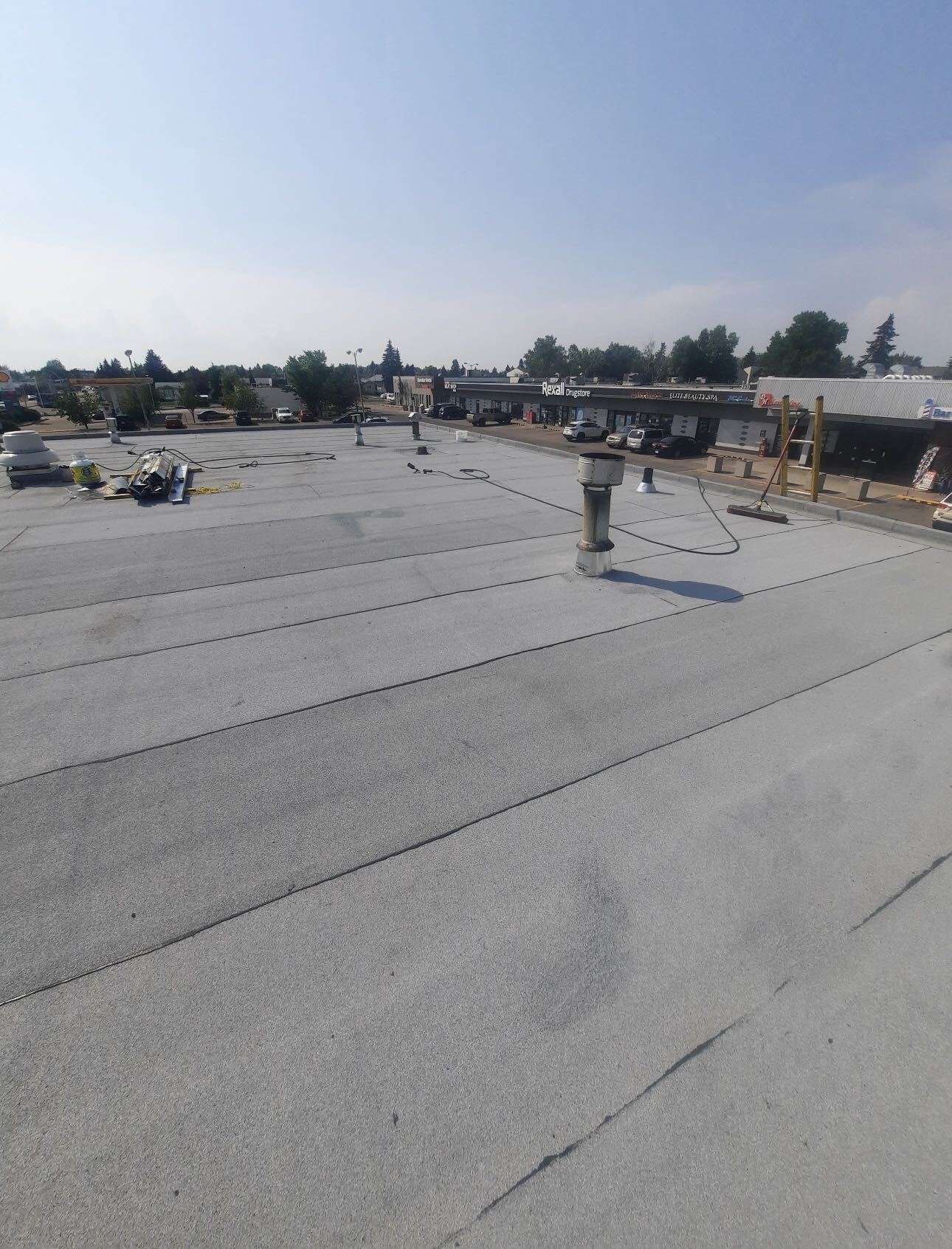
Standing water 48 hours after rain
Ponding means drainage has failed or the deck has deflected. The membrane under standing water ages far faster than the rest of the field.
Membrane roofing for the buildings that keep Edmonton working — warehouses, retail plazas, industrial, institutional, multi-family and strata. Installed, repaired and maintained by a crew whose core trade is flat roofing, not shingles.
Know what you're looking at
Ponding means drainage has failed or the deck has deflected. The membrane under standing water ages far faster than the rest of the field.
Trapped moisture or vapour under the membrane. Left alone it spreads, and every freeze–thaw cycle widens the void.
Seams are where almost every membrane roof fails first. An open lap is a direct path into the insulation and the deck.
Parapets, curbs and penetrations move with temperature. When flashing lets go, water gets in at the hardest point to trace.
A cap sheet losing granules is losing its UV protection. Shrinkage pulls the membrane tight at the edges and tears details open.
By the time it shows inside, water has usually been tracking through the assembly for a while — often far from where it entered.
Seeing any of these? A free assessment gets you a written answer on whether it's a repair, a section, or a full replacement — before it becomes a capital decision made under pressure.
What we do
Whether the roof is going in, leaking, or being kept alive another eight years, it's the same crew and the same documentation standard.
Full tear-off or overlay, insulation and vapour-barrier detailing, drains, curbs and flashings — quoted line by line.
Flat roof installationFinding where water actually enters, which is rarely where it appears inside. Targeted repair when the roof has life left.
Repair & leak investigationSpring and fall inspections with documented reports — the paperwork most manufacturer warranties require to stay valid.
Maintenance programActive leak in an occupied building? We stabilize first to stop damage to the building and its contents, then schedule the permanent repair.
Emergency repairOne point of contact across a portfolio, consistent reporting formats, and scheduling that fits your budget cycle.
For property managersSBS, TPO, EPDM, CBC and built-up compared — what each costs, how each ages in Alberta, and which suits your building.
Compare systemsFlat and low-slope roofing covers most of Edmonton's commercial building stock. The systems are similar; the constraints are not. A distribution warehouse can take a crane and a closed lane. A strip plaza with a dental office and a restaurant cannot.
On occupied buildings: most of our commercial work happens on buildings that stay open. That constraint shapes the schedule from the first site visit — it isn't something we discover halfway through.
We'd rather assess your roof and give you a real number than publish a range that turns out to be wrong for your building. What moves it:
Our own work
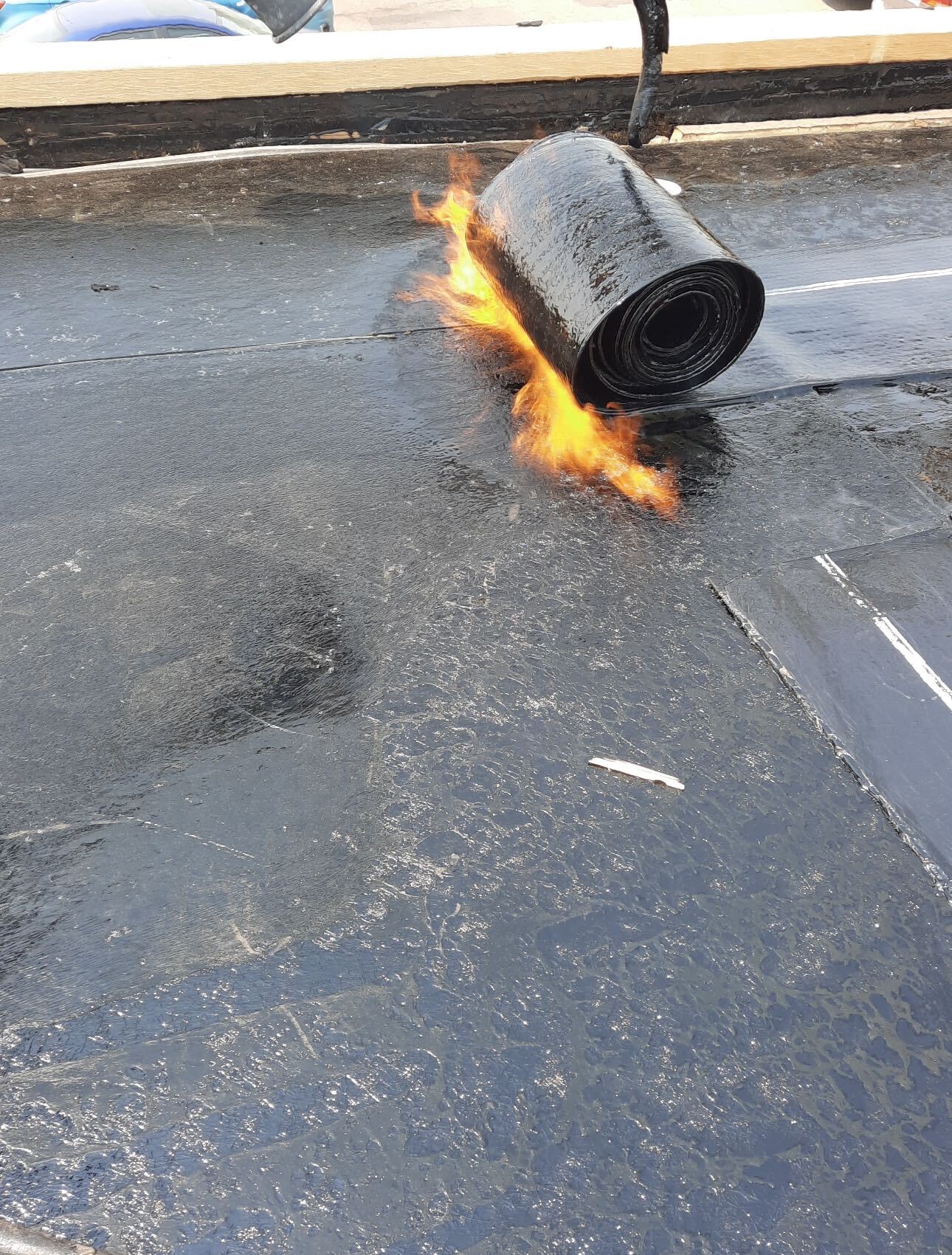
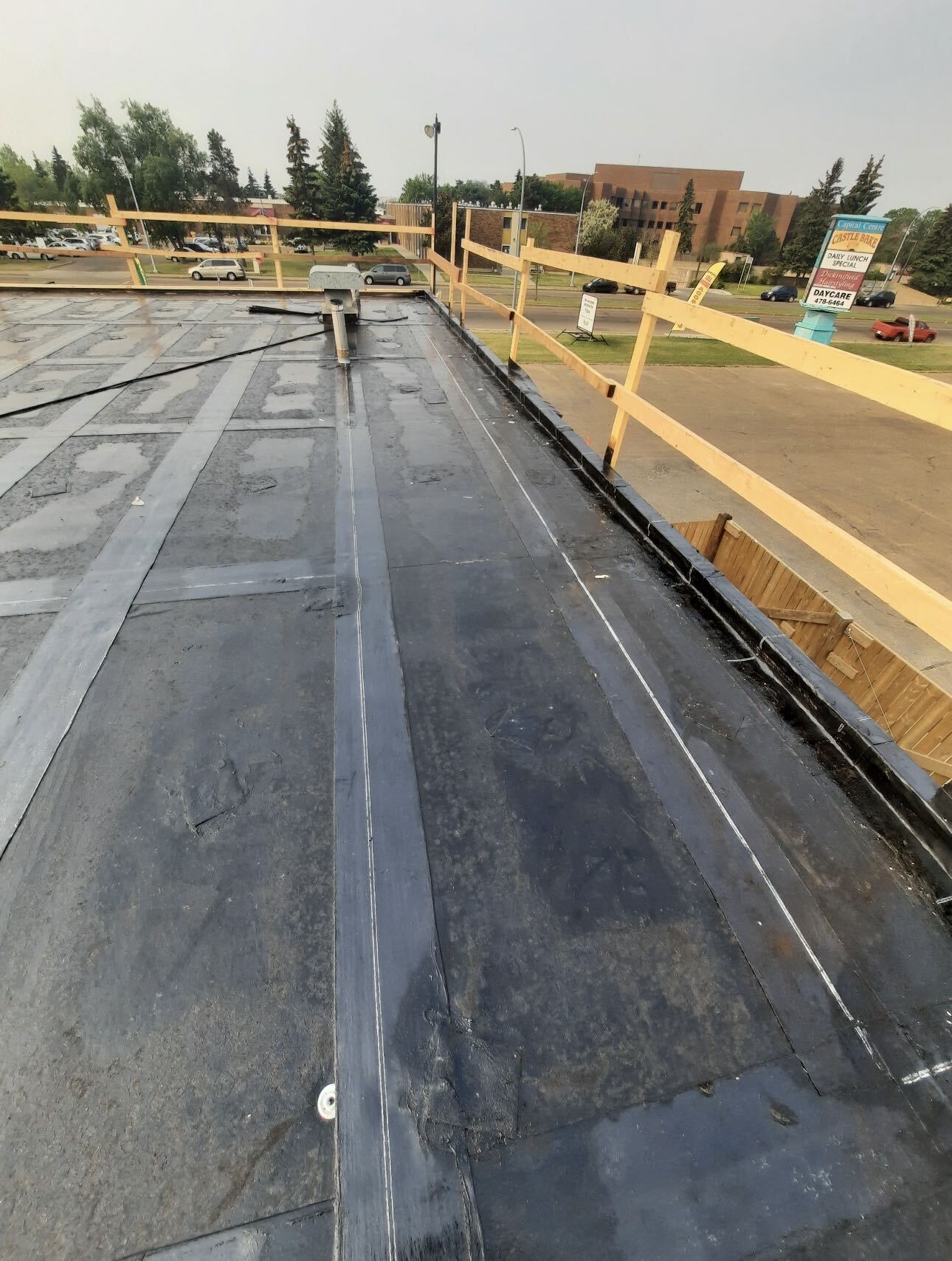
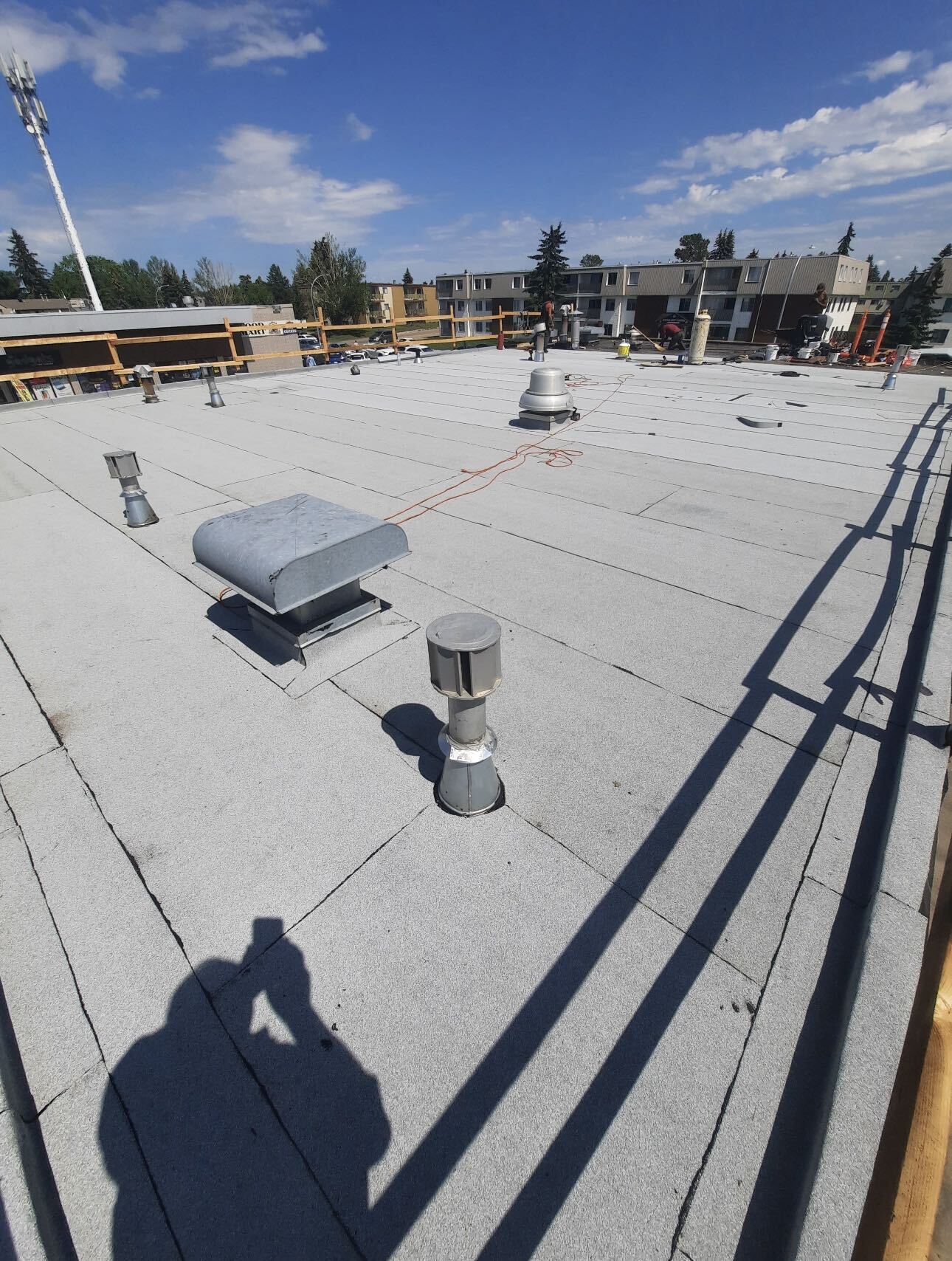
Every photo here is an iRoof job. No stock imagery.
Questions
It depends on roof area, access, deck condition and weather windows. A straightforward mid-size commercial field is usually measured in weeks, not months. We give you a scheduled window in the quote and tell you immediately if weather moves it.
Yes — most of our commercial work happens on occupied buildings. We plan staging, access and material handling around your operating hours, and coordinate anything that affects tenants in advance. The roof is tied in watertight at the end of every working day.
Often, yes. If the membrane has service life left and the problem is localized — a seam, a flashing, a drain detail — repair is the right call and we'll say so. We'll also tell you when it isn't, and why spending on a roof that's at end of life is money lost.
Both, depending on what's under there. An overlay can be a sound, cheaper option when the existing assembly is dry and the deck is sound, and code allows it. If the insulation is wet, an overlay just buries the problem — we'll core it and tell you honestly which situation you're in.
It depends on the building, its use, roof traffic, exposure and how long you plan to hold the asset. SBS handles cold and complex detailing best, which is why it dominates here. TPO suits large simple fields, and CBC fits occupied buildings where open flame isn't an option. See Roofing Systems Explained for the full comparison.
Emergency repairs, yes — a leak doesn't wait for spring. Full replacements are weather-dependent: cold and moisture affect adhesion and membrane handling, and there are temperatures below which a proper install simply isn't possible. We'll tell you when the honest answer is to stabilize now and schedule the replacement for the season.
Yes — City of Edmonton licensed (#00000), fully insured and bonded ($2M / $5M liability), with WCB coverage (account #000000) on every crew member on your property. We'll provide certificates on request before work starts.
Next step
Commercial assessments are free. Call for a quote, or leave a voicemail and we'll call you back.